Sunday, December 6, 2015

How I Found Literacy At An Animal Hospital - My Final Conclusion

This post is just a brief summery of my observations, research, and my final conclusion to my study.  I chose to research Durant Animal Hospital in Durant, OK.  This is of interest to me due to the fact that I am in my first semester of studies at Texas A & M - Commerce with a major in Pre-Vet, Animal Science.  I really wanted to make sure that I wanted to continue my studies without "wasting" four years of my middle-aged life to realize this just was not for me.

I have some experience already with animals as I have worked on a K-9 team, own/breed/show AKC English Bulldogs, own Boar Goats, and own horses.  I have loved animals all of my life and have always loved working with them.  Due to this, I had to be careful in approaching my research and observations to make sure that I explained things in detail to those reading my post would understand.  I also had to keep my writings in check as the surgical procedures I found interesting but to some of my readers they may have found these to be disturbing.

I needed to find how literacy was used at this site through my research while observing how it would fit a discourse community.  With veterinarians and staff dealing with the public on a daily basis, I found that the owners of the animals must be the voice for the animal and explain to the staff what is wrong with the animal and why they brought the animal to the facility.  Literacy therefore, plays a huge role in this practice.

Throughout my research and observations I studied many different aspects of the veterinary hospital.  Some of these were:
  • The differences in caring for the different animals and how the staff of the hospital interacted with them during this care with both the animal and the animal's owner(s).
  • Procedures in handling and caring for the smaller animal breeds like dogs and cats compared to those of horses and cattle.
  • Different safety precautions used for the different species of animals.
  • Different types of clientele.
  • How the staff explained procedures or treatments to their clients.
  • Public awareness and education for the public.
  • How the staff of the hospital worked and communicated with other.
  • Veterinary terminology.
  • How the staff, clients, and patients of the hospital communicated through sight, sound, feel/touch, smell, and the use of their voices and body language.
Through these observations  I found that tones of voice, touch, and body language were very important in dealing with the animals.  To an animal, body language can mean friendship or possible threat.  The staff's use of body language and how it is perceived from an animals view can mean the calming of the animal in order to perform the necessary procedures or the animal being scared and lashing out to the staff who are trying to perform the procedure.  Animals don't understand our spoken language and cannot communicate through this type of language, therefore they rely on body language.  A calming or reassuring touch can immediately calm down a frightened animal while offering reassurance.  You can be discussing the most grotesque procedure you are about to perform on the animal but when said in a sweet and calm tone, the animal only understand the tone and not the words therefore they react with a calm demeanor.

I discovered when dealing with clients (the animal's owners) the staff dealt with many types of emotions and verbal language.  I saw people's concerns, questions, and misunderstandings followed by their eventual understand voiced through verbal communication and body language.  I understand how a person's emotions can affect a situation and how it is being handled or perceived and just how important these emotions can be whether being expressed verbally or through one's body language.

I understand how important communication is between the staff of the hospital.  It does not matter if it is written or verbal, this communication can ultimately mean the difference between life or death.  The quick understanding of language could just safe a life.  It also means the continued care, treatment, and increased health of an animal because without proper communication, you would not know what is going on.  Language / communication is an important aspect of a veterinary practice and it's staff.

When I first entered the site, I saw people, animals, equipment, and machines.  Now I see cultural artifacts and literacy in motion.  I am really surprised at how much one can go through life looking through a tunnel but once you step back and observe and think about what you are seeing, you see observe things differently.  These observations feel like a newborn baby or child experiencing the world or something new for the first time.  You really become aware of your surroundings and just how you fit into them.  My research has also brought about a better understand of myself as a human being and just how much my literacy, spoken and unspoken, can be viewed by others and how interpretations of these can vary.  It is important to always be thinking of others when literacy is concerned.  Where my verbal language or body language to some can seem direct, to others it could feel like a knife through the chest.  In one case, my spoken words could seem empathetic by my body language may appear as stand-offish.  I know that my spoken language must match my body language in order for people to perceive and understand me correctly as this literacy aspect is now understood more clearly through my research.

Oh, and one other big questions that I wanted to answer through my research was, " Can I handle all the gore, sight, smell, and sound of a veterinary practice?  Is this really the career path I want to follow, continue with my education, and not feel that it was a waste of my time." The answer to these questions is a big, fat, and shout out loud, "YES!"

Friday, November 13, 2015

November 12, 2015 - Interview Day

Today when I arrived at Durant Animal Hospital, my objective was to obtain my interviews.  I was told previously by staff that Tuesdays and Thursdays were their slower days therefore, I scheduled my day for interviews on a Thursday.

It was still busy at the hospital and I had to make sure that I kept my interviews to a minimum. Not everyone wished to participate in the interviews and I respect their decision.  Those that did were happy to answer my questions and share their experiences and knowledge with me.  It seems that they all enjoy their work at the hospital and enjoy talking about it but like I said, not everyone wished to be "quoted" or have it put down on paper in black and white.

One thing that I did observe and felt kind of odd about was the fact that during a regular day at the hospital, communication flows freely and automatically but when faced with an interview, I had to steer my participants in certain directions in order to get the results or answers that I wanted.  For some of my interview participants, speech was difficult or short winded and I had to dig deep for complete answers.  In some cases, my observations of the daily happenings at the hospital answered my questions better than the interview itself did.

I am at this point forming a theory about people who work with animals (keep in mind that it is only a theory based on my personal opinion) and that theory is:  people who work with animals tend to understand and bond with animals better than they do with people. They tend to be more understanding of the animal(s) and communicate with them not only through spoken language but mostly through their actions and body language.  It appears that they are more comfortable forming these bonds between animal and human than they are between human and human.  The communication from human to animal is very comfortable and flows freely but the communication between human and human is something that they need to work at and comes with some form or degree of difficulty.

I have found through my observation that there is a true literacy between humans and animals.  Animals have a fight or flight reaction.  If an animal feels scared, in most cases, they will take flight but when an animal feels threatened, the fight instinct takes over and they go into fight mode.  When dealing with animals, humans tend to be more patient and use their tone of voice to aide in their interactions with them.  Animals do not understand speech but they do understand the tone used when spoken to.  You could say the stupidest or meanest thing to an animal but if spoken sweetly, that animal is going to respond to you with positive results.  Funny I know.  Body language is another form of literacy that takes place and is very important when dealing with animals.  If you go towards an animal in a threatening manner, that animal is going to perceive you as a threat and potentially react with their fight mode.  If approached in a non-threatening manner, the animal is probably going to be curious and possibly a little apprehensive but they will be approachable.  When dealing with animals, size can also mean a lot.  Think about it, if you were approached by an elephant in their own habitat, you would probably be a little scared, as just the elephant's size alone is intimidating; well the same is true for animals.  When dealing with an animal that is smaller than you and one that is scared or intimidated, the staff at the hospital tends to decrease their size (possibly getting down on hands and knees for instance) and approach that animal with care and loving concern.  This sort of approach lessens the animals fear and they become more curious, interested, and accepting about what is going to happen.  When the staff is dealing with an animal larger than them, they still approach the animal with concern but in an authoritative manner.  Every animal is used to a herd hierarchy and in that hierarchy, there is a dominant animal followed by the submissive animals. When approaching an animal that is larger than them, the staff must take that dominant factor and use it (no fear as the animals can sence it) showing the animal that they are the dominant in the herd hierarchy.  You don't want to approach a 1200 pound horse on your hands and knees in a submissive way, the horse will walk all over you.  You must approach them in a caring yet authoritative manner (saying to yourself and the horse in your body language that, "Yes, you are going to stand there and let me give you your shots and you are going to do it properly."

During my interviews and observations, I have a better understanding of the literacy that is used and takes place at an animal hospital.  This literacy can make a huge difference in how the client or patient responds to the staff and could possibly be the difference in how smoothly a procedure takes place with positive results.

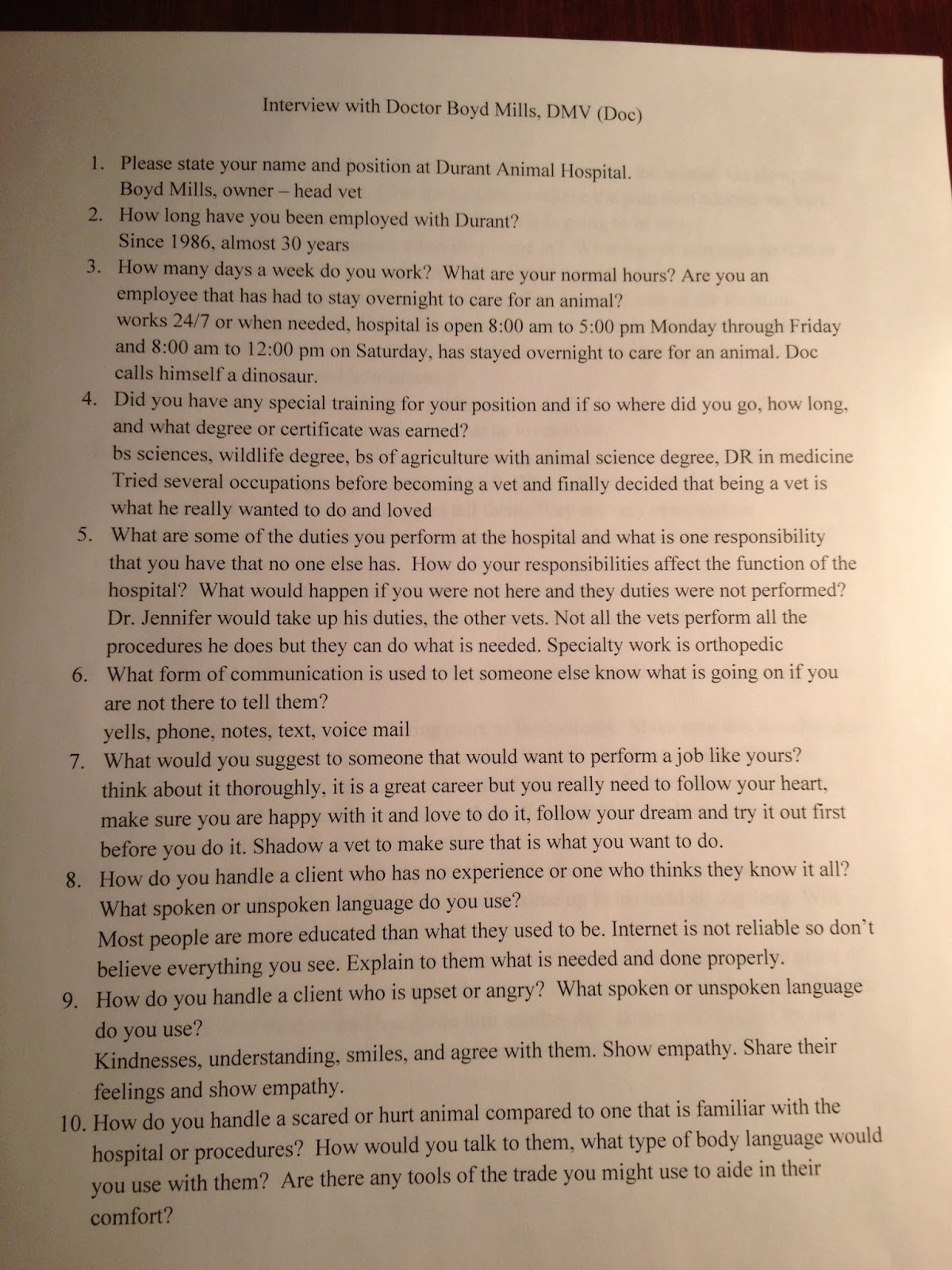
Below, you can observe my questions and the staff's answers to the questions asked during an interview.  I have also included a picture of the staff member that was interviewed.  Following the interviews, you will see copies of my field notes for the day.


Interview Questions


Doctor Boyd Mills, DMV


Wade Peterson, Kennel Assistant


Wanda Gibby (GiGi), Head Surgery Nurse


Michelle Woodson, Certified Technical Assistant and Lab Assistant


Becky Peterson, Kennel Assistant


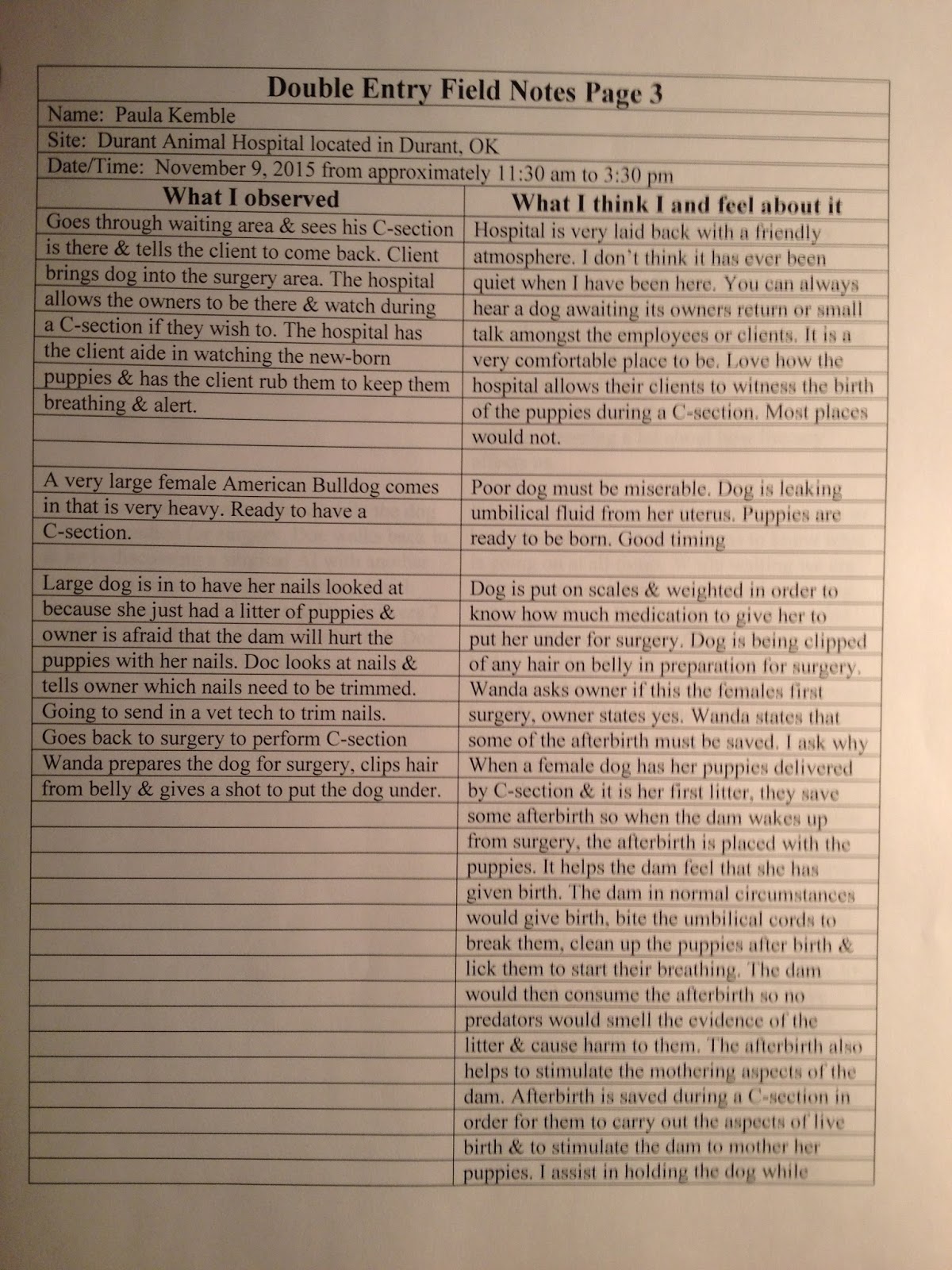
 Field notes from November 12, 2015; interview day.


Monday, November 9, 2015

Monday, November 9, 2015 Visit with field notes and pictures

It is Monday, November 9, 2015 and I arrive at the hospital at approximately 11:30 am.  It is not too busy today and I hope to really get some questions in today.  It has been almost a month since my last visit and everyone seems to remember me and I am greeting with welcoming gestures.  It appears that the staff is becoming more comfortable with my presence here.

I am told that Doc is in surgery and I walk in and am greeted warmly.  Doc jokes with me telling me that they thought they had all scared me off.  I explain to him that things have just been crazy at college and he laughs telling me that he remembers his college days.  We discuss the crosswalks at the college while he is performing a c-section, a pretty common procedure for Doc and one that I have witnessed many times already in my short time here.

Conversation is pretty intense today with a lot of veterinary terminology being used.  I am able to follow most of it and question some that I am not familiar with when time permits.  I am really observing the literacy taking place today and forming more questions for Thursday when I plan to do my interviews.  I have been told by staff members that Tuesdays and Thursday are their least busy days therefore I have chosen Thursday to perform my interviews.

The schedule at the hospital is running smoothly today and the staff goes over some of the scheduling for the upcoming week.  Doc exams some animals and jokes with the clients telling many stories of his past. I am thoroughly enjoying his stories and am able to relate to a lot of them through past experiences with my own animals.

Doc discusses some breeding procedures with me and I ask questions for better understanding.  We discuss in and out breeding and why it is important while he discusses it with a client also.  Today is a very laid back kind of day, one in which I am able to learn a lot.

A possible rabies case comes in.  This is an area that I will not observe as it can be a very touchy subject for the owner and also for my safety.  I do not know if the animal brought in is alive or already deceased.  I am told that the client already has one animal there at the hospital in quarantine being observed for possible rabies.  Doc walks out carrying a white bag which I am assuming is the deceased body of the possible rabies case.  I do not ask any questions on this very sad subject.  In this environment, not every outcome is a happy one and one I must train my heart to accept.

While Doc is at lunch, a dog with a possible broken front leg comes in.  One of the other vets is performing the exam on the dog.  The dog is brought into x-ray to have it's leg x-rayed.  I am able to view the x-ray and find the fracture in the bone. I will  include a picture of this below.  It is not everyday that one gets to view an x-ray and see the results. This is a very neat cultural artifact that I am able to share with you.

With today being a slower day, I am able to go through the hospital and take a lot of pictures of cultural artifacts which I will share with you below.  You will also be able to view my field notes for the day.


Large Capacity Automatic Autoclave - used for sterilization of surgical tools.

X-ray machine and apron

microscope
 
Catalyst One Machine - used in Chemistry - used to test chemistry profile, electrolytes, liver function, CBC testing, testing for safe administration of anesthesia dosage, thyroid disease, fructosamine / diabetic testing, phenobarbital levels and urine P:C ratio for renal disease.


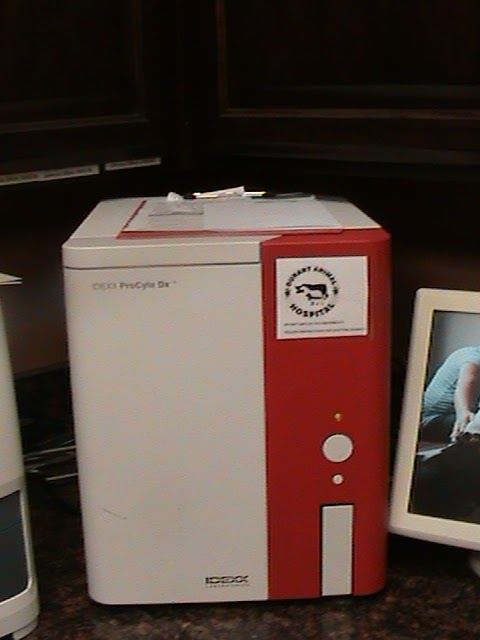
Procyte Dx - used for hematology - used to test blood count, five-part white blood cell differential, absolute reticulocyte counts, presence of band neutrophils, nucleated red blood cells, body fluid analysis, abdominal/thoracic and synovial fluid parameters.

Blood Rocker (on the left), used to mix the blood and keep it from clotting - VetLab UA (on the right)- used in urinalysis - used to test urine samples for pH, LEU (leukocytes), PRO (protein), GLU (glucose), KET (ketones), UBG (urobilinogen), BIL (biliruben), and BLD/HGB (blood/hemoglobin)


Mediums  used in testing

Multipurpose Centrifuge - A centrifuge is a laboratory device that is used for the separation of fluids, gas or liquid, based on density. Separation is achieved by spinning a vessel containing material at high speed; the centrifugal force pushes heavier materials to the outside of the vessel.

Catalyst DX - used in chemistry - comprehensive equine (horse) testing, NSAID therapy, test chemistry profile, electrolytes, liver function, CBC testing, testing for safe administration of anesthesia dosage, thyroid disease, fructosamine / diabetic testing, phenobarbital levels and urine P:C ratio for renal disease. Can test up to 30 slides at one time and results received in 7 minutes or less.

Small Animal Warming Unit with Oxygen

Medical liquids

Gauzes and Medical Tape

This is the x-ray screen with the x-ray of the small dogs leg with a fracture.

Closer picture of the x-ray showing the fracture.


Close-up of the fracture.  It is located on the upper bone in the center of the curve.


Saturday, October 10, 2015

Saturday, October 10, 2015 Visit with field notes and pictures


It is Saturday, October 10, 2015 and I arrive at the hospital shortly after they open.  The hospital is already hopping and it is hard to find a parking spot as all the parking is taken.  I park on the side of the building under a tree and out of the way.  I have stopped on my way to the hospital and purchased 2 dozen donuts to offer to the staff of the hospital as a small token of my appreciation.  I am also hoping that this token helps the staff open up to me a little more as the first day some of them were a little apprehensive to speak to me.  I guess they just need to feel me out and see what I am all about.

I walk into the hospital carrying the donuts and it already seems to be working.  Everyone appears to be in a good mood and the donuts seem to help the mood.  The hospital is busy and people and pets are everywhere.  I feel that I have chosen a good day to observe.  I get to meet a lot of the staff today that I did not meet yesterday which will be good for my research.

It seems that I am everywhere today.  It is a good thing that I have worn my comfortable shoes.  I am able to observe a lot of the staff, clients, different animals and procedures.  I am really taking a lot of notes today and trying to take it all in.  I am observing how the staff interacts with the clients and the animals being seen.  The donuts have seemed to work their magic and the staff is opening up to me a lot, answering my questions and allowing me to observe and take pictures.

Below you will be able to see my field notes for the day and observe some of the pictures I have taken today.


Husky puppy receiving his first round of puppy shots and wellness exams.


Cat receiving an IV.


Checking sperm counts.
Time to clean up.


Caviler King Charles Spaniel getting ready for C-section & delivered puppies afterwards in recovery.  Puppies just born and being rubbed to get them breathing.  Clamps on umbilical cords waiting for them to seal.